Dual-Witness C-II Waste: Best Practices for Veterinary Teams
How to implement dual-witness waste protocols that satisfy DEA requirements without slowing down your team.
Marcus Webb is a Licensed Veterinary Technician with eleven years of experience in high-volume emergency and specialty hospitals. He has been responsible for controlled substance protocol design, staff training, and DEA record management across 24/7 clinical environments where speed and accuracy are non-negotiable.
Why Dual-Witness Matters
Under 21 CFR §1304.22, waste of controlled substances must be witnessed by a second authorized person. In veterinary practice, this typically means a licensed veterinarian or credentialed technician is physically present during disposal and co-signs the record.
The regulatory intent is straightforward: two witnesses make diversion significantly harder to conceal. A single-signature waste entry leaves an accountability gap that DEA field inspectors are trained to identify.
Who Can Witness?
The DEA's definition of an "authorized witness" for waste is intentionally broad, but state law may impose stricter requirements. In general:
| Role | Can Witness? | Notes |
|---|---|---|
| Licensed DVM | ✓ Yes | Always authorized |
| CVT / RVT / LVT | ✓ Yes | Credentialed vet tech; verify your state's credential tier |
| Veterinary assistant (non-credentialed) | ⚠️ Varies | Only under direct DVM supervision; some states require licensure |
| Front desk / receptionist | ✗ No | Not considered an authorized witness for controlled substance purposes |
Always verify current requirements with your state veterinary medical board. Credentialing requirements for witnesses are evolving as more states adopt updated controlled substance rules.
Free Dual-Witness C-II Waste SOP Template
A ready-to-customize Standard Operating Procedure template for dual-witness C-II waste — includes witness qualification criteria, remote witness protocol, and documentation requirements.
Download Free SOP TemplateWhat the Record Must Include
Per 21 CFR §1304.04, each waste entry must contain the following fields. VetRx Ledger captures all of these automatically:
| Field | Required? | How VetRx Ledger Captures It |
|---|---|---|
| Date and time | ✓ Required | Auto-stamped at submission (ISO 8601) |
| Drug name and strength | ✓ Required | From vial ledger (barcode/OCR/manual) |
| Quantity drawn | ✓ Required | DRAW event qty |
| Quantity wasted | ✓ Required | WASTE event qty |
| Lot number | ✓ Required | From vial entry |
| Patient name / record number | ✓ Required | Optional patient field (privacy-preserving) |
| Administering clinician identity | ✓ Required | DVM ID on event record |
| Witness identity | ✓ Required | Witness user ID + biometric auth |
| Signature of administering clinician | ✓ Required | WebAuthn signature (hardware-backed) |
| Signature of witness | ✓ Required | Witness WebAuthn signature |
Common Failure Modes
- Retroactive witnessing."I'll get someone to sign it at the end of the shift." This creates an audit gap — the record shows a waste time of 10:15 AM and a witness signature timestamped 5:30 PM. DEA investigators flag timestamp inconsistencies.
- Same-person dual-signature. An employee signing both lines — using different pens, different initials, or different devices registered to the same identity — is a fraud indicator. VetRx Ledger blocks this at the server level: the witness user must differ from the primary submitter.
- Shared tablet credentials. When an entire team shares a single login on the room tablet, individual accountability evaporates. VetRx Ledger requires per-person WebAuthn registration — each team member enrolls their own biometric.
- Token reuse. If your system issues a witness code that can be reused (e.g., a static PIN or a standing "witness code" that never changes), a single co-worker can authorize any waste remotely without being present. Tokens must be single-use and time-limited.
How VetRx Ledger Enforces Dual-Witness
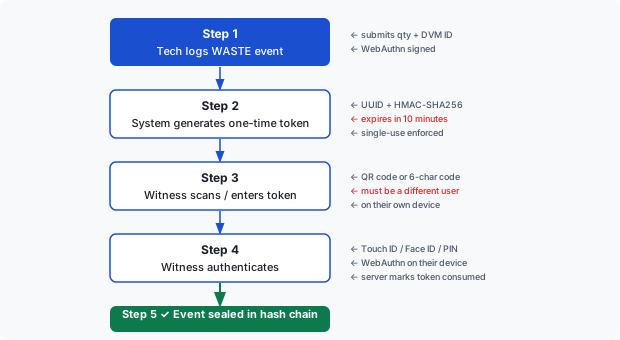
VetRx Ledger's dual-witness implementation is architecturally enforced — not just a UI reminder:
- Tech initiates a WASTE event and submits their WebAuthn-signed authorization.
- The server generates a one-time witness session token (UUID + HMAC-SHA256). The token expires in 10 minutes and can be consumed exactly once.
- The token is displayed as a QR code and a 6-character alphanumeric code on the primary device.
- A second tech or DVM opens VetRx Ledger on their own device and enters or scans the token.
- The server validates: token exists, not expired, not consumed, witness ≠ primary submitter.
- Witness authenticates with their registered biometric (Touch ID, Face ID, or PIN).
- Server atomically marks the token consumed and seals both identities into the event hash.
- The sealed event is appended to the hash chain. The WASTE event is not accepted without a valid witness token — the ledger balance does not update until both signatures are present.
Protocol Tips for Busy Hospitals
- Assign a waste witness rotation. Designate one credentialed tech per shift as the primary waste witness. This person is the default call when anyone needs to waste a C-II. Reduces the friction of hunting for an available witness mid-procedure.
- Post the witness QR shortcut at each anesthesia station. A QR code on the wall links directly to the witness confirmation screen, saving the witness 30 seconds of navigation.
- Quick-pick drugs.VetRx Ledger's quick-pick panel pre-populates the most common C-II drugs (morphine, hydromorphone, fentanyl, butorphanol, ketamine). The witness doesn't need to search for the drug name — just scan the token and confirm.
- Brief all new staff on token time limits. New team members sometimes panic when a token expires. The correct response: cancel, generate a fresh token, call the witness back. No escalation needed — token generation is always available.
Documentation Retention
DEA regulations (21 CFR §1304.04(a)) require controlled substance records to be retained for a minimum of 2 years. VetRx Ledger retains the full hash-chained event log indefinitely within the application. For off-device backup — which is strongly recommended:
- Export the chain-of-custody JSON monthly from the Ledger page
- Store the export in a password-protected, access-controlled location (not a shared Google Drive folder)
- Cross-reference exports with your DEA purchase records (Form 222 / 222C invoices) annually
Each chain export includes the witness identity, witness timestamp, witness WebAuthn signature reference, and consumed token ID for every WASTE event — giving you complete documentation in a single downloadable file.
Try the dual-witness demo
See the full WASTE + dual-witness flow on the demo ledger. No account required.
Open Demo Ledger →Get compliance updates in your inbox
Monthly DEA regulation updates, inspection prep tips, and SOP guides for veterinary teams. No spam, ever.